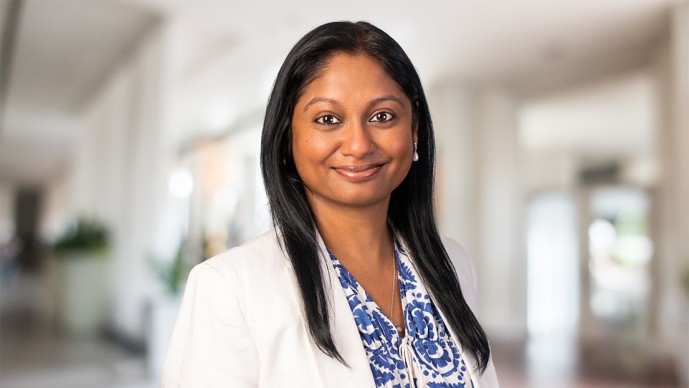
Sheetal Silal
Honorary Visiting Research Fellow in Tropical Disease Modelling
About Sheetal
Sheetal Silal always loved math but she didn't find her studies in quantitative finance at university appealing enough to follow the typical track into the corporate sector. By her third year, she felt stuck. Then, a professor suggested she take a course in operational research, which uses mathematics and computer simulation to support real-world decision-making. It clicked.
While getting her master's in operational research at the University of Cape Town, Sheetal spent two years doing statistical work on maternal mortality. She saw that despite well-intentioned health policies, pregnant women faced many challenges in trying to access services. By simulating how ideas would play out before they are implemented, Sheetal realized her modeling expertise could help shape more impactful public health policies.
"Our ability as modelers to mimic the effect of policies on a computer allows us to gain insights to improve implementation in a way that has the potential to impact millions of lives. This is what drew me to stay in public health," said Sheetal, now director of the Modelling and Simulation Hub, Africa at the University of Cape Town, where she is also a professor.
For her PhD, Sheetal built models simulating how malaria is transmitted in Mpumalanga, an eastern province in South Africa that borders Mozambique. Based on this work, she expanded her models to include different species of malaria and calculated how much it would cost to try to eliminate malaria. Soon after, she began applying her models all over the world, from Asia-Pacific to South America and on the African continent.
Back home in South Africa, with support from scientists and led by the national government, Sheetal modeled multiple scenarios looking at what it would take to eliminate malaria, and how much would it cost. The only scenario that showed the possibility of elimination in South Africa was investing in reducing malaria cases in Mozambique, due to a higher burden of malaria there. The idea that one country would contribute to funding another's malaria control activities was novel terrain. But the South African government funded the scenario and in 2023, received a special award from WHO for these landmark investments.
Since then, Sheetal has branched out to other public health issues. She is developing and continuing to work on models for COVID-19, mosquito-borne diseases, early childhood diseases, and is currently working to support pandemic preparedness for countries across the African continent.
For Sheetal, success is not only when decision makers follow the recommendations from models, but when they consider modeling as a source of evidence in the first place. To empower decision-makers in their engagement with modeling, she is running a program to teach policymakers from national malaria programs in Africa how to interpret modeling results, including thinking critically about what data was used, and the role they play in a modeling project. Being more fluent in modeling would enable policymakers to engage more deeply with the modelers and develop more locally suitable policies. Her long-term goal is to help modeling become an essential part of the evidence presented during the decision-making process.
"What Africa needs now, is more policy modelers. Then governments can tap into their own local expertise and that's great for us all," said Sheetal.
Key Publications
Advancing malaria reactive case detection in a Zambia-like setting: A modeling study
Strengthening health policy modelling in Africa
Modelling the Cost-Effectiveness of Hepatitis A in South Africa
The role of modelling and analytics in South African COVID-19 planning and budgeting
Grand Challenges Awards
Malaria Modeling Field-Strengthening: MMALA
Initiative: Grand Challenges Global Call-to-Action
Challenge: Building Malaria Modeling Capacity in Sub-Saharan Africa
Learn more about the award
Aug 8, 2022
Climate-Focused Analytics and Modeling for Mosquito-Borne Infections in Southern Africa (CAMMISA)
Initiative: Grand Challenges
Challenge: Strengthening Health and Disease Modeling for Public Health Decision Making in Africa
Learn more about the award
Nov 1, 2024
Major Funding Awards and Honors
Epidemic Science Leadership and Innovation Network Award
Modelling Team Award for Women's, Children's and Adolescent Health in Eleven Countries
Featured Photos and Videos


