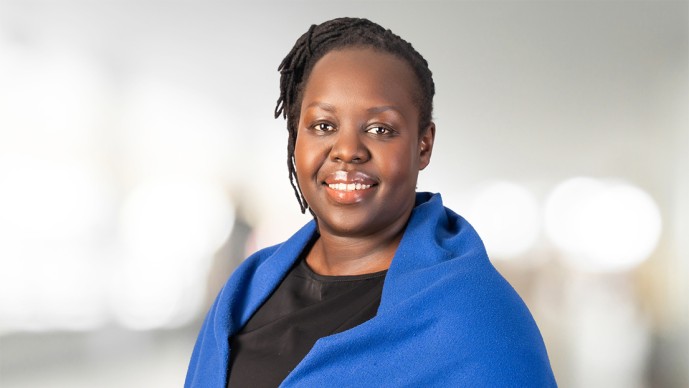
Hellen Barsosio
Chief Investigator / Assistant Principal Clinical Research Scientist
Principal Clinical Research Scientist
About Hellen
Hellen Barsosio's father is the firstborn of his family. But he was his mother's ninth pregnancy.
Hellen grew up seeing what the loss of the first eight pregnancies did to her grandmother, once a vivacious woman whose natural curiosity made her a skilled herbalist, a forerunner of today's research scientists. She carried this loss with her in her daily life.
"It shaped the type of researcher I wanted to be - to do whatever I can to ensure that pregnant women have healthy babies and that those babies have a fighting chance at life," said Hellen, assistant principal clinical research scientist at Kenya Medical Research Institute (KEMRI).
Hellen is researching what malaria treatments and vaccines can be safely administered to pregnant women. For malaria, the few treatment options available are ineffective because pregnant women are typically excluded from clinical trials for fear of harming the fetus - a problem that is not limited to malaria.
As part of this work, Hellen set up Kenya's largest pregnancy research platform, which includes 45,000 women of reproductive age. The platform tracks the safety of drugs given during pregnancy and will soon expand to include maternal vaccines.
During her malaria research, Hellen spent a lot of time with the women of Mfangano Island, a tiny island in Lake Victoria only accessible by a daily water bus. She saw how little access the pregnant women there had to life saving interventions during pregnancy, including maternal vaccines, prompting her to shift her focus towards improving the policies that will enable maternal immunizations to reach the people who need them.
So, in addition to her malaria work, Hellen is now leading efforts for the Maternal Immunisation Readiness Network in Africa and Asia across nine countries to ensure they have the policies, healthcare system infrastructure, and financial resources needed to deliver the maternal vaccines when they become available.
A maternal vaccine for the respiratory syncytial virus (RSV), which can protect newborns from the deadly virus from their first breath through the mother's antibodies, recently came on the market in high-income countries. Meanwhile researchers are close to producing a vaccine for Group B Streptococcus, a bacterial infection that can cause stillbirths, miscarriages and neonatal mortality if contracted early in the pregnancy.
"I realized that the women will only get the vaccines and interventions they need if the government is convinced that it's worth the investment," said Hellen. "Pushing policy is an uncomfortable zone for us researchers, but we must go out of our way to translate our research into a language policymakers can understand so our work makes it to the people that need it."
Key Publications
How Can We Accelerate Maternal Vaccination Globally?
Major Funding Awards and Honors
In the News
ASTMH Young Investigator Award Winner
Dr Hellen Barsosio: Success follows her like a shadow
A forum to nurture women in science
New drug under test to help mothers beat malaria
Africa-Europe partnership to launch historic Phase 3 clinical trial in early pregnancy
New drugs to prevent malaria during pregnancy
Share this content
Associated Gates Foundation Strategy
Pneumonia
Our goal: