Strengthening Country-Led Cholera Modeling for Evidence-Based Policy Decisions

**NOTE: This opportunity was open only to institutions who had been invited directly by email.
Before applying, applicants should familiarize themselves with the supporting documents for this Grand Challenge, including the Rules and Guidelines, Application Instructions, and Frequently Asked Questions.
Background
Cholera continues to impact multiple countries, some presenting with transmission in endemic areas, some in outbreak-prone hotspots, and some with both endemic and epidemic transmission patterns. Interventions should include improving access to clean water in Priority Areas for Multisectoral Interventions (PAMIs), and reactive and/or preventive oral cholera vaccine (OCV) use. Yet, these interventions are expensive in the face of decreased global funding for vaccines and international aid. Countries have to weigh alternative interventions, and better target interventions to minimize costs, and such policy decisions could be informed by modeling.
There is a significant disconnect between desired simplicity in outputs by some country partners v/s the capabilities of models and nuances in interpreting outputs. In countries where sub-national surveillance data exist, in-country modeling expertise can be leveraged to enhance cholera modeling capacity, while also working with cholera modeling technical experts to further develop tools relevant for local questions and locally available data.
Through this RFP, we aim to fund a consortium approach to tackle these issues in 3 countries.
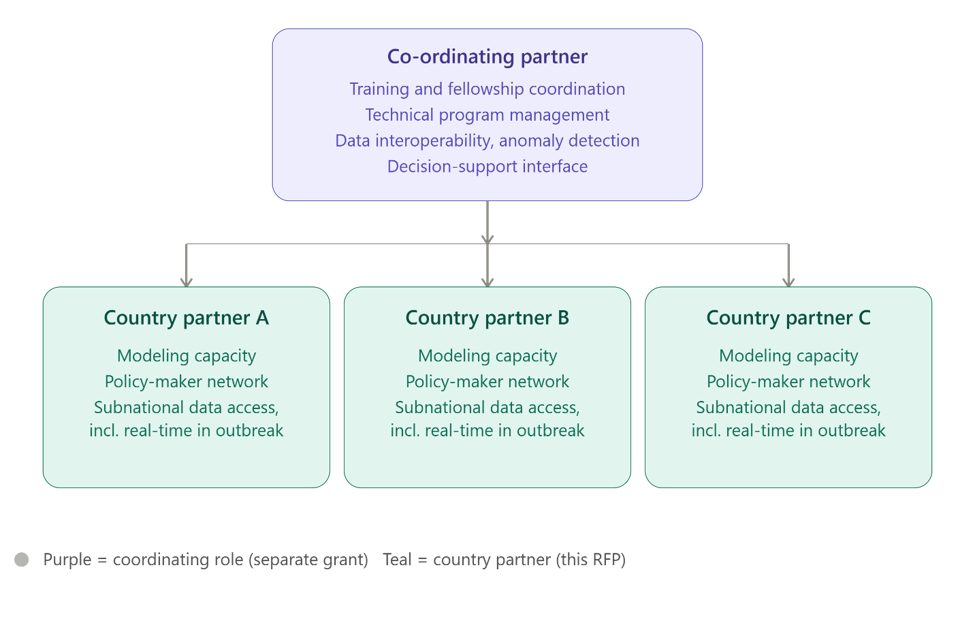
Our goals are to:
- Accelerate impactful in-country use of subnational cholera data for decision-making: accelerate real-time assessment of cholera risk and burden, enable efficient OCV and Water Sanitation and Hygiene (WASH) response planning, and strengthen iterative feedback from data à decisions
- Foster multi-country coordination/communication and sharing on useful tools, visualizations, AI-enabled approaches as work progresses
- Create sustainable structure and demonstrate value of using underutilized data to ministries of health
The Challenge
This RFP seeks to leverage existing disease modeling capacity in the country to undertake cholera modeling using local data to address locally relevant questions to inform decision-making in cholera control.
- The RFP is only open to modelers and partners based in the country where cholera data are to be analyzed and modeled.
Specifically, the objectives of the challenge will be:
- Address pressing policy-relevant questions to inform cholera control in the country
- Enhance capacity amongst modelers to undertake cholera modeling in collaboration with cholera decision-makers in government
- Utilize existing cholera surveillance data in country to understand risk and target interventions
- Build capacity among policy makers to engage with and use modeling support to inform decision-making
- Promote leadership and independence in cholera modeling
- Build an international cohort of cholera modelers and policy makers who can exchange methods and learnings
- Inform policy and program decision-making via scalable tools
- Leverage AI to create scalable and sustainable data à decision processes
Funding Level
We will consider proposals for awards of up to $500,000 USD (inclusive of indirect costs) for each project, with a grant term of up to 3 years. Application budgets should be commensurate with the scope of work proposed. Indirect costs should be included within this total budget, up to a maximum of 15% of the award (subject to the Gates Foundation's indirect cost policy).
Eligibility Criteria
This initiative is open to nonprofit organizations, for-profit companies, government institutes and agencies, and academic institutions that 1) are based in one of the listed cholera-impacted countries1; and 2) have existing relations with government decision-makers and entities holding cholera surveillance data. Applicants should be able to show access to cholera surveillance data and should align with their decision-makers and institutions before submitting a proposal as no more than one award will be given to a single institution.
We are looking for proposals that:
- Are led by an organization with existing expertise and/or experience in infectious disease modeling that: 1) have access to sub-national cholera surveillance data in the country (must clarify the administrative level at which data are available), 2) have existing relationships with organizations/institutes engaged in cholera surveillance, and 3) have existing relationships or are willing to network with cholera decision-makers in the country.
- Focus on cholera modeling, with a focus including but not limited to outbreak prediction and forecasting, scenario analysis to inform choice of intervention and geographic prioritization for interventions, and cost-effectiveness analyses of alternative interventions. Applicants must utilize methods that clearly link subnational data to decision-making, and can include but should move beyond risk stratification across the country, to utilize approaches to enable evaluation across intervention arms and strategies.
- Prioritize policy-relevant modeling questions.
- Demonstrate institutional support and partnerships necessary for collaborative work with country surveillance leads and decision-makers.
- Conduct analyses beyond what has already been funded and/or published.
- Result in at least three policy briefs.
- Investigators should be willing to work with international cholera modeling technical partners, and to present their methods and insights in meetings with other technical leads and policy makers in this cohort. Policy leads should be willing to undertake a fellowship program designed to build understanding and expertise in engaging with modelers to address pressing policy questions. These resources will be supported by a separate grant to international partners directly from the Gates Foundation.
- Contribute to sustainable capacity for cholera modeling to be available to policy makers, and to be conducted independently in the future.
We will not fund proposals that:
- Aim to collect or generate new data through this funding.
- Propose descriptive analyses alone.
- Propose analyses that overlap with results already funded and/or published.
- Are not led by a country-based investigator.
- Do not demonstrate how the investigator has access to sub-national cholera surveillance data in country
- Do not demonstrate existing or planned engagement with country policy makers
- Do not demonstrate willingness to build a network in country focused on using modeling to address cholera policy questions
- Do not demonstrate a clear commitment to engaging in training led by international partners in cholera modeling and modeling use by policy makers.
1 Bangladesh; Burundi; DRC; Ethiopia; India; Kenya; Malawi; Mozambique; Nigeria; Zambia